
Learning Objective
Mix colors using additive light theory and the RGB color model.
The Physics of Color (RGB LED)
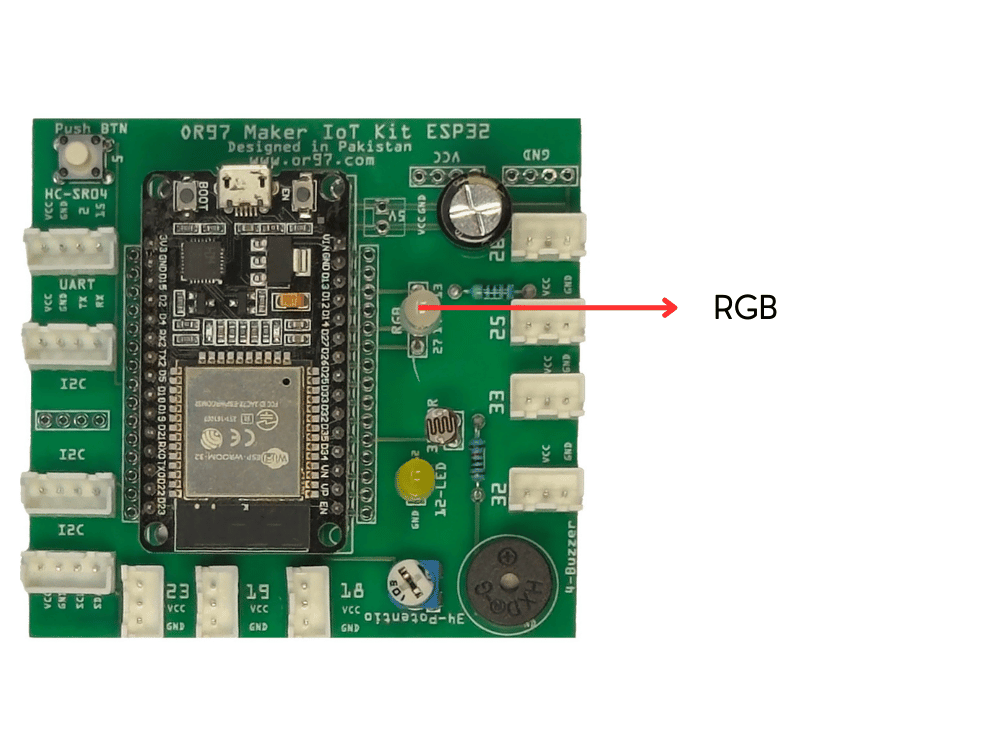
Hardware: embedded RGB LED
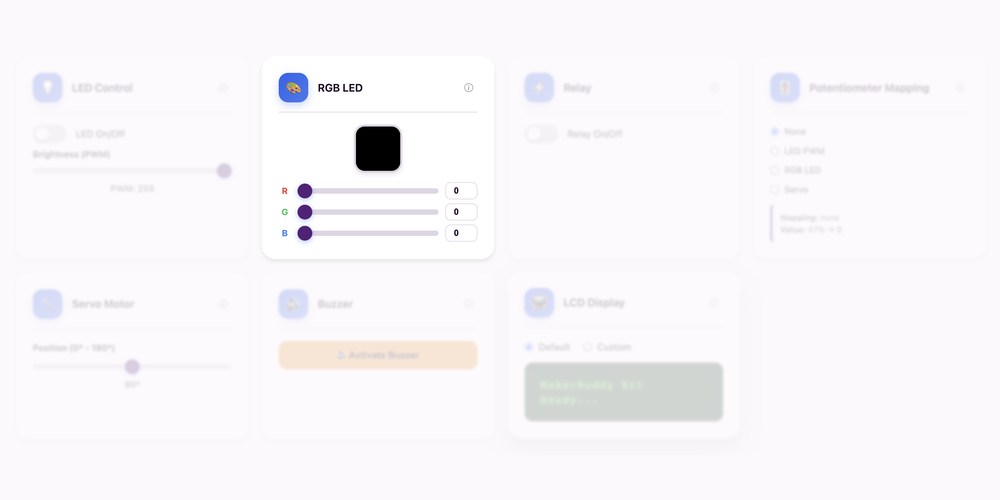
Dashboard: RGB LED Control Card
Theory: RGB Color Model
The Science of Light and Color
Everything you see on a screen - from your smartphone to a giant TV - creates millions of colors using just three: Red, Green and Blue. This isn't magic; it's the RGB color model, one of the most important discoveries in display technology. Unlike mixing paints (which uses subtractive color), mixing light follows additive color theory where combining lights makes colors brighter, not darker.
Additive Color Mixing
When you mix paint, adding more colors makes the result darker (subtractive mixing). But mixing light works the opposite way - it's additive. When you shine red light and green light together, you get yellow. Add blue to that and you get white! This is exactly how your computer monitor, phone screen and the RGB LED on your MakerBuddy board work. Each pixel on a screen contains three tiny lights (red, green and blue) and by controlling their brightness, you can create any color imaginable.
Understanding RGB Values (0-255)
In the digital world, each color channel (Red, Green, Blue) is controlled by a number from0 to 255. This gives us 256 different brightness levels per channel. Why 256? Because computers use 8-bit numbers (2^8 = 256). When you set Red=255, Green=0, Blue=0, you get pure red at full brightness. Set all three to 255 and you get white. Set all to 0 and you get black (no light). With three channels each having 256 levels, you can create 256 × 256 × 256 =16,777,216 different colors! For example: Purple is approximately RGB(128, 0, 128), Yellow is RGB(255, 255, 0) and Cyan is RGB(0, 255, 255).
How RGB LEDs Work
Your MakerBuddy IoT Board has an RGB LED, already embedded and connected, which is actually three tiny LEDs (one red, one green, one blue) packaged together in a single component. By controlling the brightness of each internal LED using PWM (Pulse Width Modulation - remember Week 4?), you can mix these three primary colors of light to create any color. The microcontroller rapidly adjusts the duty cycle of each color channel and your eye perceives the combined result as a smooth, solid color.
For Teachers
This lesson bridges physics and digital technology. Demonstrate additive color mixing using colored flashlights in a darkened room if possible. Emphasize the difference between mixing paint (subtractive) and mixing light (additive). Use the RGB sliders to show how intermediate values create different shades - for instance, RGB(255, 128, 0) creates orange. Challenge students to predict colors before testing them. Connect this to real-world applications: stage lighting, photography, graphic design and even how their favorite video games render graphics. The 0-255 range ties back to binary and how computers represent data.
For Parents
This week introduces the RGB color model, the same technology used in every screen your child interacts with. Understanding how three simple colors create millions of variations connects to art, photography and digital design careers. Your child is learning the fundamental difference between mixing paints (subtractive) and mixing light (additive). This knowledge applies to graphic design software, video editing and understanding how displays work. It's also a great introduction to how computers represent information using numbers - in this case, 0-255 for each color channel.
Hands-On Activity: Color Mixing
Activity Duration: 15-20 minutes
In this colorful exploration, students will experiment with the RGB LED control card in their MakerBuddy dashboard to create various colors through additive light mixing. This hands-on activity demonstrates the practical application of color theory and digital color representation.
Step-by-Step Instructions:
- Locate the RGB LED: It is already embedded and connected on the MakerBuddy IoT Board, so no wiring is needed.
- Access RGB Control: Navigate to your MakerBuddy dashboard and locate the RGB LED control card. You should see three separate sliders labeled Red, Green and Blue, each ranging from 0 to 255.
- Primary Colors Test: Start by testing each primary color individually. Set Red to 255 while keeping Green and Blue at 0. Observe the pure red light. Repeat for green (0, 255, 0) and blue (0, 0, 255).
- Create Yellow: Set Red to 255 and Green to 255, with Blue at 0. The RGB LED should produce a bright yellow color. This demonstrates that red light + green light = yellow in additive color mixing.
- Create Magenta: Set Red to 255 and Blue to 255, with Green at 0. You should see a vibrant magenta (sometimes called purple). This is red light + blue light combining.
- Create Cyan: Set Green to 255 and Blue to 255, with Red at 0. The result is cyan, a bright blue-green color. This is green light + blue light mixing.
- Create White: Set all three channels to 255. The RGB LED should produce white light, proving that combining all three primary colors of light at full intensity creates white.
- Experiment with Shades: Try intermediate values. For example, set RGB to (255, 128, 0) to create orange or (128, 0, 128) for purple. Notice how changing individual channel values affects the resulting color.
What Students Should Observe:
- How two primary colors combine to create secondary colors (yellow, magenta, cyan)
- The difference between full intensity (255) and partial intensity (128, 64, etc.)
- How lowering all values simultaneously creates darker versions of colors
- The instant response when adjusting slider values, demonstrating real-time digital control
Pro Tip
Have students create a "color journal" where they record RGB values for interesting colors they discover. For example: Sunset Orange (255, 100, 0), Ocean Blue (0, 128, 255), Forest Green (34, 139, 34). This helps them understand how digital artists and web designers specify exact colors in their work!
Challenge
Your Mission: Color Palette Creator
Now that you understand how RGB values create colors, it's time to put your knowledge to the test! Your mission is to create specific colors using only the RGB sliders, without using any external color picker tools.
Challenge 1: Create Teal
Teal is a blue-green color. Think about which primary colors you need to combine and what intensity levels would create this specific shade. Write down the exact RGB values you discover. (Hint: You'll need Green and Blue, but how much of each?)
Challenge 2: Create Orange
Orange sits between red and yellow on the color spectrum. Since yellow is made from red + green, how would you create orange? Experiment with different ratios until you get a true orange color. Document your RGB values.
Bonus Challenge: Create three additional colors of your choice (e.g., lavender, coral, lime green) and write down their RGB values. Can you create a color palette for a specific theme, like "sunset" or "ocean"? How would a graphic designer use this knowledge in their daily work?
Success Criteria: You successfully complete this challenge when you can reliably create the requested colors and explain why your RGB value choices produce those specific colors. Understanding the "why" behind color mixing is just as important as achieving the correct color!
Key Takeaways
✓ RGB Color Model
The RGB color model uses three primary colors of light (Red, Green, Blue) to create millions of colors. Every screen you use - from smartphones to TVs - relies on this model to display images. Understanding RGB is fundamental to digital design, photography and display technology.
✓ Additive Color Mixing
Unlike mixing paints (subtractive), mixing colored lights is additive - combining colors makes them brighter, not darker. Red + Green = Yellow, Red + Blue = Magenta, Green + Blue = Cyan and all three together create white light. This principle powers all digital displays.
✓ Color Values (0-255)
Each RGB color channel is controlled by values from 0 to 255, giving 256 brightness levels per channel. This 8-bit system (2^8 = 256) allows creation of 16,777,216 unique colors. Understanding this range is essential for digital color specification in design and programming.
✓ Primary Colors of Light
Red, Green and Blue are the primary colors of light, different from the primary colors in painting (red, yellow, blue). All other colors can be created by combining these three at different intensities. This concept is the foundation of how RGB LEDs and display pixels work.
Coming Up Next Week:
Week 6: Digital Inputs (The Button)