
Repeatable across classes
Keyed connectors and onboard components reduce common setup errors. Reset the kit, change the brief and use it again with the next group.
MakerBuddy for schools
Give students a clear path from first sensor reading to coded IoT prototype with reusable classroom hardware, structured resources and educator support.
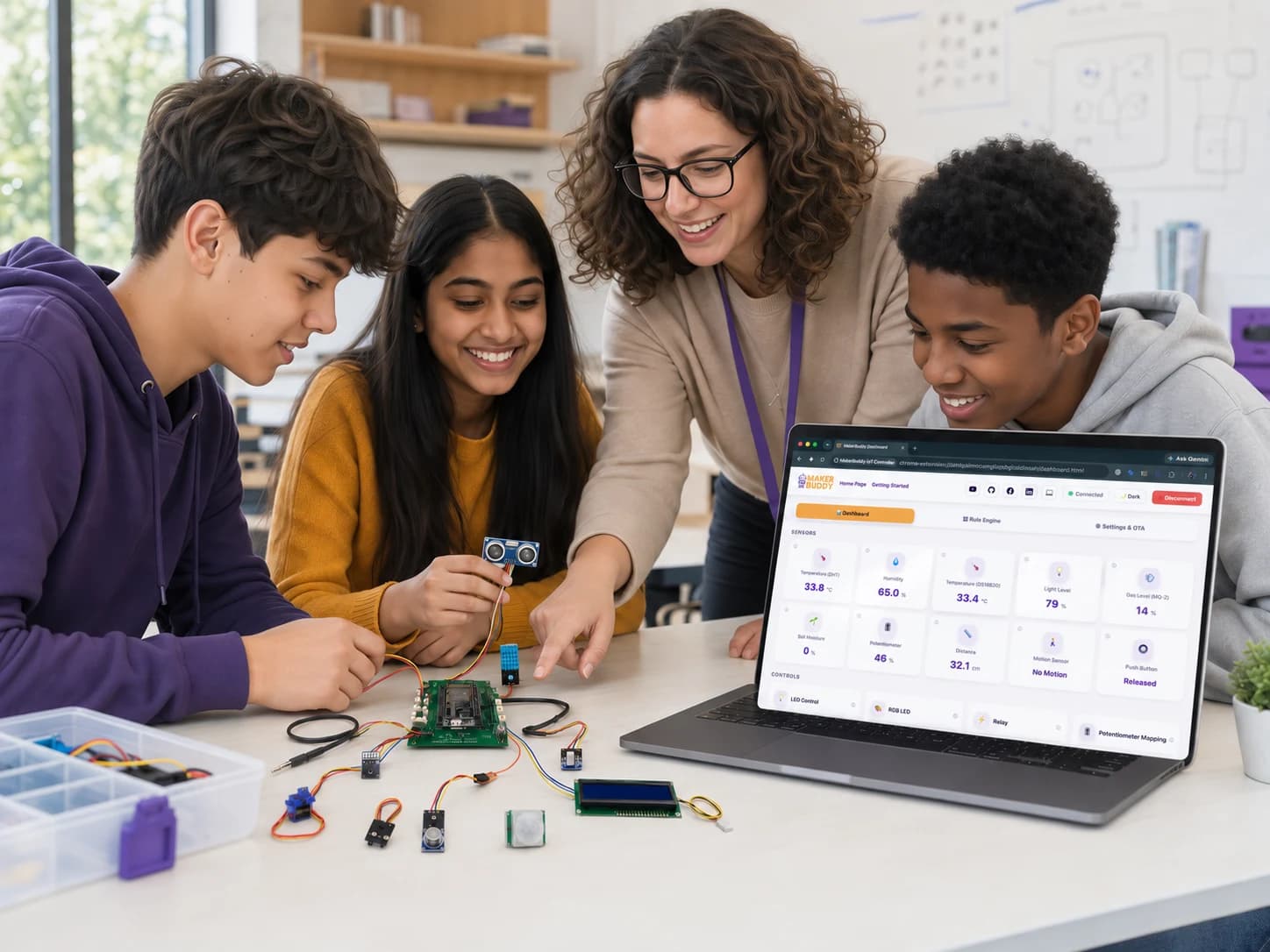
MakerBuddy combines reusable ESP32 hardware, a browser-based dashboard and a structured learning path in one classroom platform. Students spend the lesson investigating, building and explaining connected systems—not waiting for a circuit to work.
Keyed connectors and onboard components reduce common setup errors. Reset the kit, change the brief and use it again with the next group.
New learners begin with visible data and no-code rules. Advanced learners move into Arduino, APIs and open-ended engineering without switching platforms.
Students predict, test, document, debug and defend their decisions. A working prototype makes computational thinking and design practice visible.
Use the 32-week curriculum as a complete progression or select modules to support computing, science and design learning.
Run a weekly maker club where students move from guided builds to team-owned inventions and a final showcase.
Frame a challenge around sustainability, accessibility or smart spaces, then ask teams to prototype and present a response.
Use the same kit for facilitator onboarding: explore the hardware, model a lesson and rehearse common troubleshooting scenarios.
Algorithms, Boolean logic, variables, control flow, event-driven systems, APIs and introductory embedded programming.
Measurement, calibration, patterns, thresholds, uncertainty and evidence-based conclusions using real sensor readings.
Problem definition, rapid prototyping, test criteria, iteration, documentation and communication in small teams.
ESP32-based hardware, compatible sensors and actuators, a local browser dashboard and a route into real code.
A structured curriculum, project prompts, technical documentation and examples educators can adapt.
Reusable kits, open-source software and standard interfaces that protect your program from a locked, one-way learning path.
Schools and colleges in Pakistan, the USA, Canada, UK, Europe and the Middle East can request a written quote and delivery timeline by email. Orders in Pakistan are fulfilled through production partner OR97. Review ordering options, or email info@makerbuddy.cc with your institution, country, delivery city, expected learner count and preferred start date.
Plan your rollout
Talk with us about class size, educator onboarding, kit ratios and a rollout that fits your timetable.