
Learning Objectives
- Understand what electronics is and how a simple circuit turns electricity into a useful action
- Explain the Input → Process → Output cycle behind every smart device
- Describe what automation is and how a rule lets a device decide for itself
- Understand what the Internet of Things (IoT) adds on top of automation
- Classify everyday devices as electronic, automated or IoT
From Electronics to Automation to IoT
Welcome to Week 1! Before we build anything, let's understand the three ideas this whole course is built on — and how each one grows out of the one before it.
The Big Picture: Three Steps
People often use the words electronics, automation and IoT as if they mean the same thing. They don't. They are three steps of the same journey, and each step keeps everything from the step before it.
1. Electronics
Electricity flows through a circuit and makes something happen — a light glows, a buzzer sounds, a sensor reads the room.
2. Automation
The circuit is given a rule, so it decides for itself when to act. No human has to press the switch.
3. IoT
The automated device is connected to a network, so it can be watched and controlled from anywhere.
Step 1: What is Electronics?
Electronics is the art of controlling electricity so it does something useful for us. A torch is electronics: a battery pushes electricity through a switch and a bulb, and you get light. Your MakerBuddy board is the same idea, just with far more components on it.
Four words explain almost everything you will meet this term:
| Term | What it means |
|---|---|
| Voltage (V) | The “push” that moves electricity. MakerBuddy works at a safe 5V and 3.3V — nothing like the 220V in a wall socket. |
| Current (A) | The amount of electricity actually flowing. Bigger components, like a motor, need more current. |
| Circuit | A complete loop for electricity to travel around. If the loop is broken anywhere, nothing works. |
| Component | A part with a job: an LED makes light, a buzzer makes sound, a sensor measures something. |
Components fall into two families, and you will use both every single week:
Sensors — the senses
They measure the world and turn it into a number the board can read: light (LDR), temperature (DHT11), distance (HC-SR04), movement (PIR).
Actuators — the muscles
They change the world when the board tells them to: an LED lights up, a buzzer sounds, a servo turns, a relay switches something on.
The Pattern Behind Everything: Input → Process → Output
Every project in this course — and every smart device you have ever used — follows the same three-stage pattern.
Input
Something is measured or pressed: a button, an LDR reading the light, a temperature sensor.
Process
The brain (the ESP32 on your board) compares the reading against a rule and decides what to do.
Output
Something happens in the real world: an LED turns on, a buzzer sounds, a servo moves.
Example — an automatic corridor light: the motion sensor detecting a person is the input; the rule “if motion is detected, switch the light on for 30 seconds” is the process; the light turning on is the output.
Step 2: What is Automation?
Automation is what happens when we give the circuit a rule and let it make the decision itself. The human stops being the switch.
Compare the two:
| Manual (electronics only) | Automatic (automation) |
|---|---|
| You press a switch to turn on the fan. | The fan turns itself on when the room passes 30 °C. |
| You water the plant when you remember. | The pump runs whenever the soil sensor reads “dry”. |
| You open the shop door. | The door opens when a sensor detects someone approaching. |
The rule is almost always written in the same shape — you will build dozens of these later in the course:
Why it matters: automation is faster than a person, never forgets, works at night, and can react to things humans cannot even feel — like a gas leak or a one-degree change in temperature.
Step 3: What is IoT?
An automated device is clever, but it is also alone. It cannot tell you what it is doing, and you cannot change its mind from the next room — let alone from another city.
The Internet of Things (IoT) is a network of physical objects (“things”) embedded with sensors, software and connectivity, so they can exchange data with other devices and with us over a network. In one sentence: IoT = automation + connectivity.
Adding a network connection gives an automated device three new powers:
Monitor
See live sensor readings on a phone or dashboard, wherever you are.
Control
Switch things on and off, or change a rule, without touching the device.
Alert & Record
Get warned when something goes wrong, and keep a history of readings to spot patterns.
Put together, a full IoT system has four parts:
- Sensors / Devices: these collect data from their environment (e.g., a temperature sensor).
- Connectivity: the data is sent over Wi-Fi, Bluetooth or a cellular network.
- Data Processing: software processes the data and may decide to act (e.g., “it's too hot, turn on the AC”).
- User Interface: the information is made useful through an app, dashboard or website.
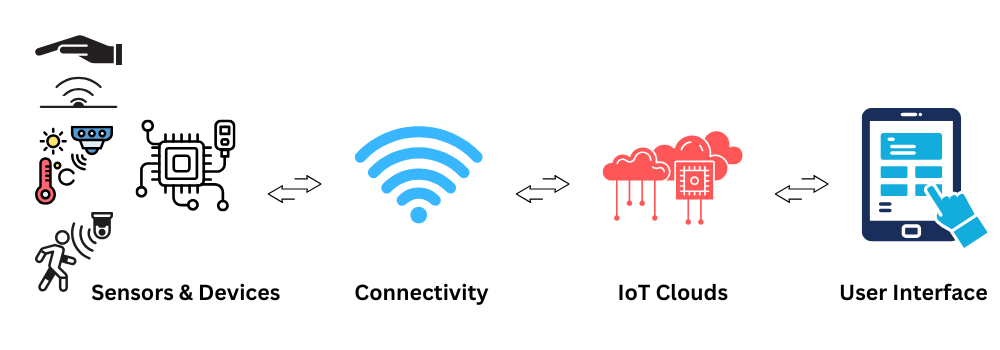
Basic IoT Architecture Flow
Telling Them Apart
Use this table whenever you are not sure which of the three you are looking at.
| Question | Electronics | Automation | IoT |
|---|---|---|---|
| Does electricity do something useful? | Yes | Yes | Yes |
| Does it decide by itself? | No — a person decides | Yes — a rule decides | Yes — a rule decides |
| Can you reach it from far away? | No | No | Yes — over the network |
| Everyday example | A torch, a doorbell | A washing machine, an automatic gate | A smart bulb, a fitness band |
Where MakerBuddy Fits
Your MakerBuddy IoT Board is designed to take you through all three steps in one year:
- Term 1 — Foundations (electronics): you meet the board, power it up, and make LEDs, buzzers and buttons work.
- Term 2 — Sensing & Motion: you add sensors so the board can measure temperature, distance and movement, then make things move and switch with motors and relays.
- Term 3 — Displays & Logic: you sense invisible hazards like gas and soil moisture, report on a screen, and write your first automation rules.
- Term 4 — Automation & IoT: you write the rules, then monitor and control the whole system from the dashboard.
The board already carries its own brain (an ESP32 microcontroller), Wi-Fi, and a web dashboard — so you can concentrate on ideas instead of wiring.
Activity: Sort the Devices
Look around your home, school or street and list six devices. For each one, decide which of the three groups it belongs to and write down why:
- Electronics — a person has to operate it every time.
- Automation — it follows a rule on its own, but stays offline.
- IoT — it follows a rule and you can see or control it from a phone.
For every device you list, also name its input (what it senses) and its output (what it does).
Weekly Challenge
Design Your Dream Smart Device!
Pick any object in your room and upgrade it through all three steps.
Requirements:
- Draw a picture of your device.
- Electronics: name one sensor (its input) and one actuator (its output).
- Automation: write its rule as a single IF … THEN … sentence.
- IoT: describe what you would see on your phone screen, and one thing you would be able to control remotely.
Key Takeaways
- Electronics is controlling electricity to do something useful, using sensors (senses) and actuators (muscles).
- Every device follows the same pattern: Input → Process → Output.
- Automation adds a rule — IF this THEN that — so the device decides for itself.
- IoT adds connectivity, so the device can be monitored, controlled and alert you from anywhere.
- Each step builds on the one before it, and MakerBuddy takes you through all three.