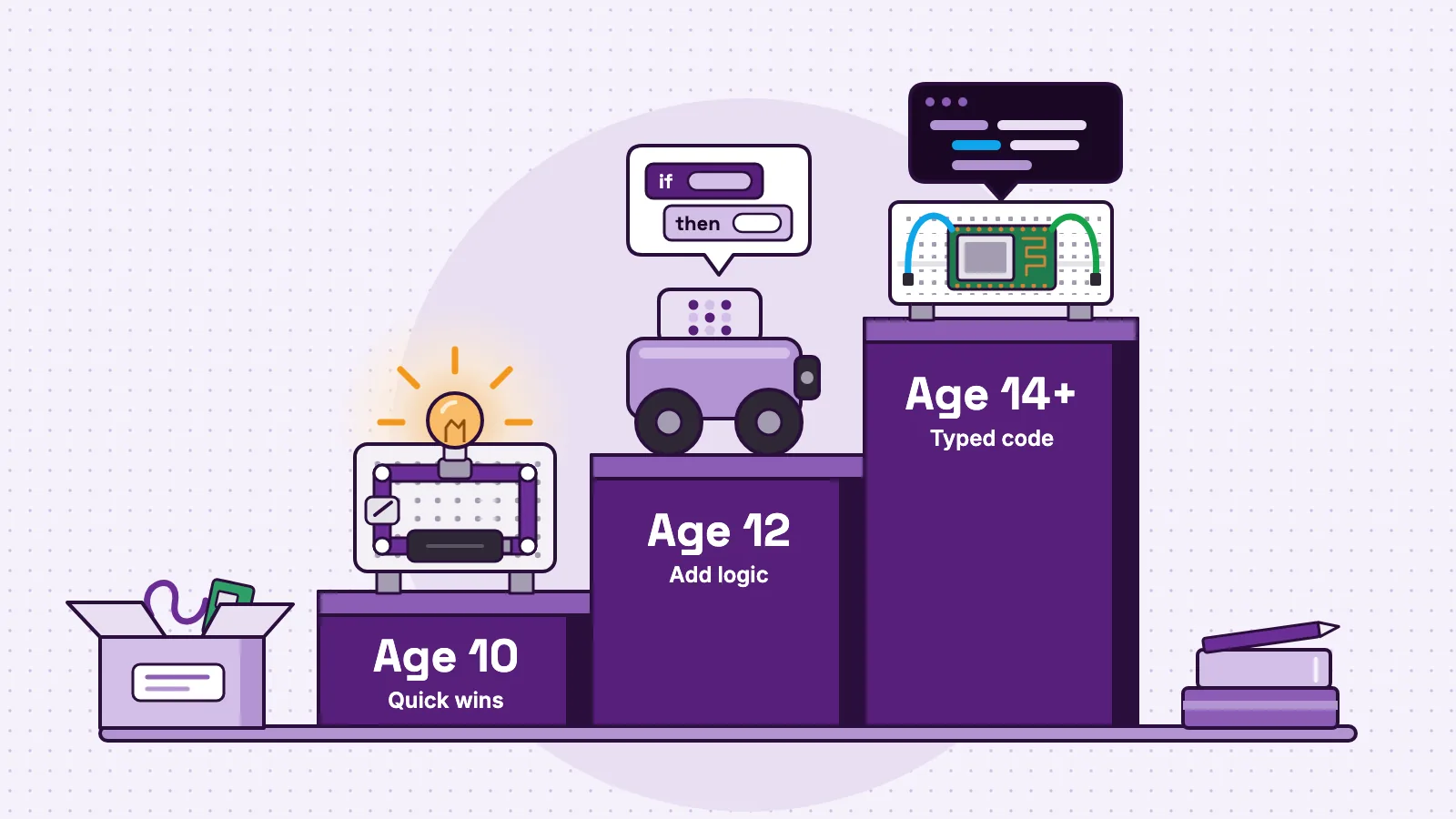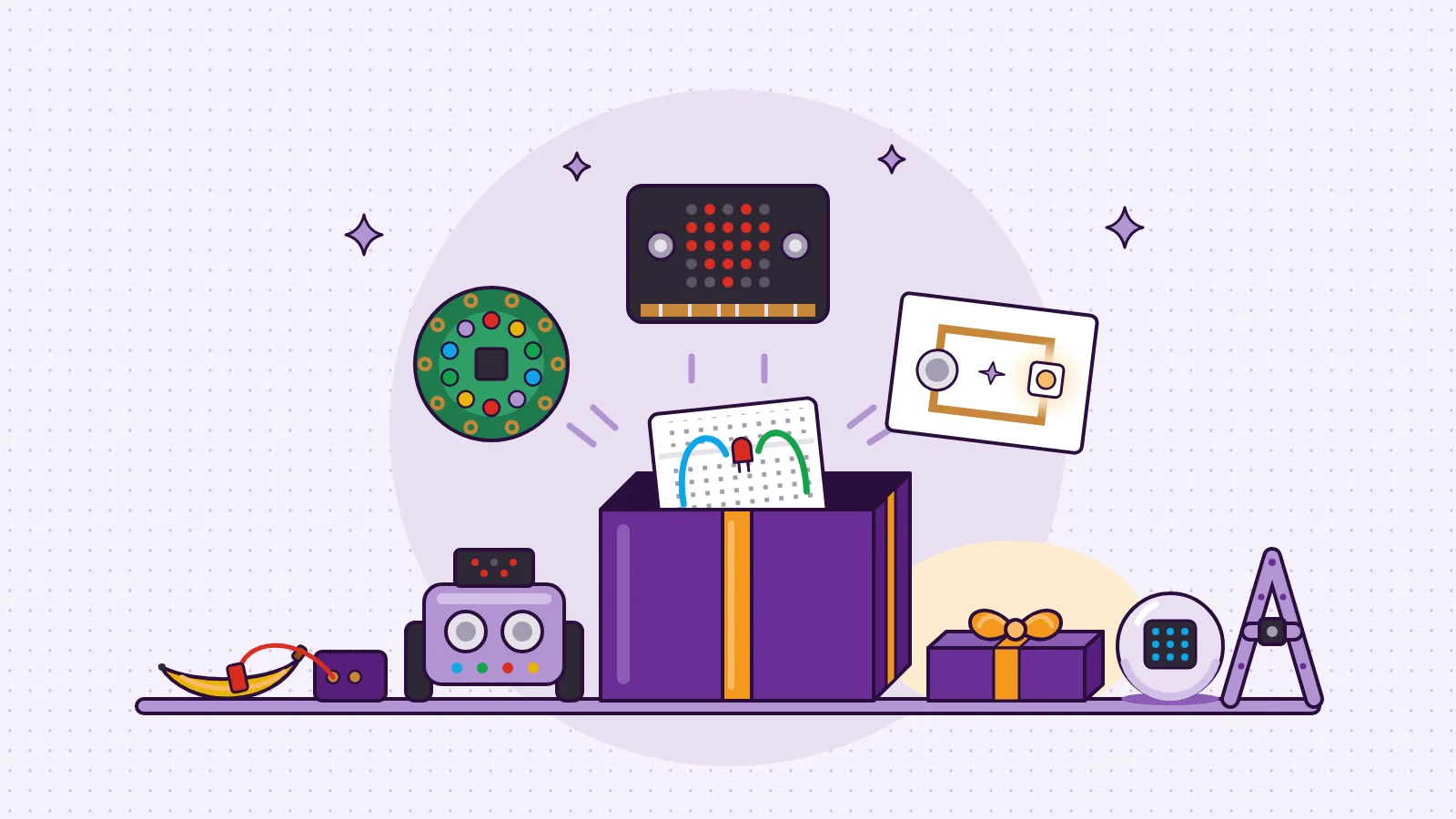
The best gifts for 12 year old boys and girls who love building let them make something that works, then change it. At 12, that usually means real parts: a small board they can code, a robot car they program, an invention kit that turns everyday things into buttons, or a sensor kit that reacts to the room. Pick by budget first, then by what your child already loves. Under $30, a programmable board gives a lot for the money. From $30 to $75, look at circuit stickers, invention kits and a robot car. From $75 to $150, choose a plug-together Wi-Fi kit or a starter kit with real wiring. Above that come robot sets and big build kits. Each pick gives its price, what it teaches, what else you need and when it is the wrong buy.
A disclosure first. We make MakerBuddy, one of the kits here, and it gets its own section with the case against it. Every other product is described from its seller's page or from Purdue University's Engineering Gift Guide. We have not bench-tested them, and there are no affiliate links. Prices are in US dollars.
Gifts for 12 year olds at a glance
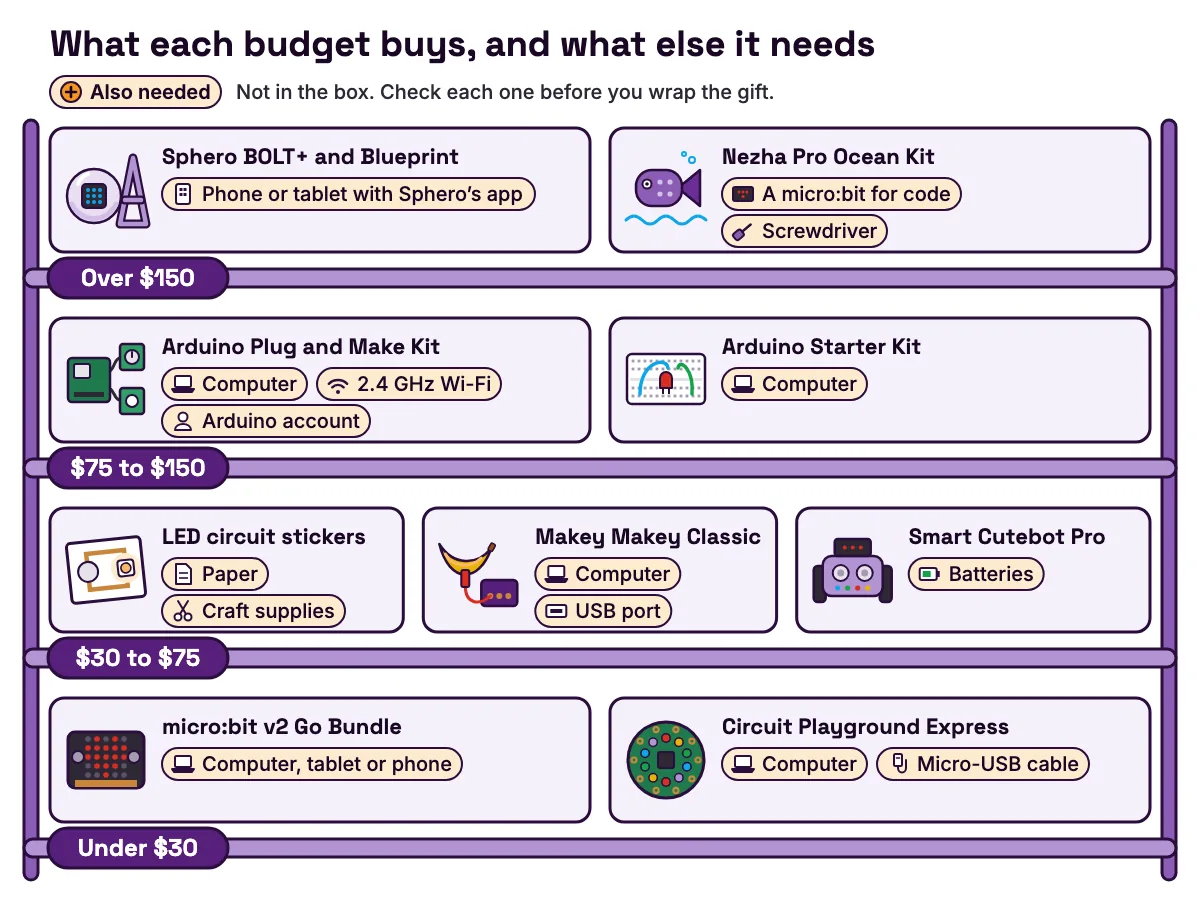
| Gift | Price (USD) | What it teaches | Also needed |
|---|---|---|---|
| micro:bit v2 Go Bundle | $19.95 | Blocks, then JavaScript or Python | A computer, tablet or phone |
| Circuit Playground Express | $24.95 | Blocks, Python or Arduino code | A computer and a micro-USB cable |
| Chibitronics LED circuit stickers | $39.99 | How a circuit flows | Paper and craft supplies |
| Makey Makey Classic | $53.50 | Inputs, circuits and what conducts | A computer with a USB port |
| Smart Cutebot Pro, with micro:bit | $71.99 | Motors, sensors and code | Batteries |
| Arduino Plug and Make Kit | $87.99 | Arduino code and Wi-Fi, no wiring | A computer, 2.4 GHz Wi-Fi, an Arduino account |
| Arduino Starter Kit | $110.00 | Wiring, typed code and debugging | A computer |
| Sphero BOLT+ with Blueprint kit | $239.00 | Drag-and-drop to JavaScript, moving structures | A phone or tablet with Sphero's app |
| Nezha Pro Ocean Kit | $261.99 | Building with sensors | A micro:bit for code, a screwdriver |
| MakerBuddy IoT Kit V1.0 | PKR 40,000 in Pakistan; a quote elsewhere | Sensors and if-then rules, no code to start | A supported device, 2.4 GHz Wi-Fi, a USB charger and cable |
- Gift
- micro:bit v2 Go Bundle
- Price (USD)
- $19.95
- What it teaches
- Blocks, then JavaScript or Python
- Also needed
- A computer, tablet or phone
- Gift
- Circuit Playground Express
- Price (USD)
- $24.95
- What it teaches
- Blocks, Python or Arduino code
- Also needed
- A computer and a micro-USB cable
- Gift
- Chibitronics LED circuit stickers
- Price (USD)
- $39.99
- What it teaches
- How a circuit flows
- Also needed
- Paper and craft supplies
- Gift
- Makey Makey Classic
- Price (USD)
- $53.50
- What it teaches
- Inputs, circuits and what conducts
- Also needed
- A computer with a USB port
- Gift
- Smart Cutebot Pro, with micro:bit
- Price (USD)
- $71.99
- What it teaches
- Motors, sensors and code
- Also needed
- Batteries
- Gift
- Arduino Plug and Make Kit
- Price (USD)
- $87.99
- What it teaches
- Arduino code and Wi-Fi, no wiring
- Also needed
- A computer, 2.4 GHz Wi-Fi, an Arduino account
- Gift
- Arduino Starter Kit
- Price (USD)
- $110.00
- What it teaches
- Wiring, typed code and debugging
- Also needed
- A computer
- Gift
- Sphero BOLT+ with Blueprint kit
- Price (USD)
- $239.00
- What it teaches
- Drag-and-drop to JavaScript, moving structures
- Also needed
- A phone or tablet with Sphero's app
- Gift
- Nezha Pro Ocean Kit
- Price (USD)
- $261.99
- What it teaches
- Building with sensors
- Also needed
- A micro:bit for code, a screwdriver
- Gift
- MakerBuddy IoT Kit V1.0
- Price (USD)
- PKR 40,000 in Pakistan; a quote elsewhere
- What it teaches
- Sensors and if-then rules, no code to start
- Also needed
- A supported device, 2.4 GHz Wi-Fi, a USB charger and cable
Table note: seller prices, checked on 29 October 2026, come from Adafruit (micro:bit (opens in a new tab), Circuit Playground Express (opens in a new tab)), SparkFun (Makey Makey (opens in a new tab)) and Arduino's US store (Plug and Make (opens in a new tab), Starter Kit (opens in a new tab)). The rest are as listed in Purdue's 2025 guide (Chibitronics (opens in a new tab), Cutebot Pro (opens in a new tab), Sphero (opens in a new tab), Nezha (opens in a new tab)). Shipping and tax are extra.
Purdue's guide is a useful second opinion. Its 2025 edition (opens in a new tab), released on 10 November 2025, picked 10 microelectronics gifts, and a research team evaluated each one for circuitry, robotics, and coding. Five of its picks appear in this post.
How to choose a building gift a 12-year-old will use
The right gift fits what your child can do today and leaves room for next month.
The US Consumer Product Safety Commission's Age Determination Guidelines (opens in a new tab) describe children aged 9 through 12. They often prefer raw materials to finished products, so they can make something of their own. They can follow multi-step instructions, so complex model kits suit them, and they can build with tiny screws, gears, nuts and bolts.
Ask three questions before you buy:
- 1
Does it work on the first day?
A first win keeps a child going, so a kit that needs two evenings of wiring needs a patient builder.
- 2
Can they change it?
A booklet of fixed projects is finished when the booklet is. A board they can code keeps going.
- 3
What else does it need?
Batteries, a computer, an app, Wi-Fi, an account or a second product sold separately.
Pick by interest, not by the aisle. Lists of gifts for 12 year old girls and lists for boys often sort by colour and theme. For a child who loves building, what the parts can do matters far more, and every gift here suits a girl or a boy. Match it to what they already love:
| If your 12-year-old loves | Look at | Why it fits |
|---|---|---|
| Art and crafts | Chibitronics circuit stickers | The lights become part of a card |
| Music and games | Makey Makey | Fruit and pencil drawings become keys |
| Robots and cars | Smart Cutebot Pro or Sphero BOLT+ | Code makes something move |
| Gadgets that react | Circuit Playground Express or MakerBuddy | Lights and sounds respond to the room |
| How things work inside | Arduino Starter Kit | Real wiring and a book of builds |
| Plants, animals or the sea | MakerBuddy or the Nezha Pro Ocean Kit | Sensors measure the world around them |
- If your 12-year-old loves
- Art and crafts
- Look at
- Chibitronics circuit stickers
- Why it fits
- The lights become part of a card
- If your 12-year-old loves
- Music and games
- Look at
- Makey Makey
- Why it fits
- Fruit and pencil drawings become keys
- If your 12-year-old loves
- Robots and cars
- Look at
- Smart Cutebot Pro or Sphero BOLT+
- Why it fits
- Code makes something move
- If your 12-year-old loves
- Gadgets that react
- Look at
- Circuit Playground Express or MakerBuddy
- Why it fits
- Lights and sounds respond to the room
- If your 12-year-old loves
- How things work inside
- Look at
- Arduino Starter Kit
- Why it fits
- Real wiring and a book of builds
- If your 12-year-old loves
- Plants, animals or the sea
- Look at
- MakerBuddy or the Nezha Pro Ocean Kit
- Why it fits
- Sensors measure the world around them
Gifts under $30
Small programmable boards give a lot for the money, because they keep teaching long after the first afternoon. Both need a device to send code to them.
micro:bit v2 Go Bundle, $19.95. Adafruit lists the micro:bit v2 Go Bundle (opens in a new tab) at $19.95, with the board, a short USB cable, a battery holder and two AAA batteries. The micro:bit features page (opens in a new tab) lists buttons, a grid of lights that also senses light, a microphone, a speaker, a compass, a motion sensor, and radio and Bluetooth. Its coding page (opens in a new tab) starts with colour-coded blocks, lets your child switch to JavaScript and offers Python, with apps for phones and tablets too. The case against: motors and bigger sensors mean buying add-ons, such as the robot car below.
Circuit Playground Express, $24.95. Adafruit lists the Circuit Playground Express (opens in a new tab) at $24.95. One round board carries 10 colour lights, a motion sensor, light, temperature and sound sensors, a small speaker, two buttons and pads for crocodile clips. It codes with MakeCode blocks or JavaScript, CircuitPython or the Arduino IDE, so it can grow with your child. The case against: it has no Wi-Fi, and the micro-USB cable is an add-on.
A real toolbox. A child who builds from cardboard and old toys gets a lot from proper tools: small screwdrivers, a craft knife with a cutting mat, a low-temperature glue gun and masking tape. Agree the rules for the knife and the glue gun first.
Try before you spend. All 32 MakerBuddy lessons are free to read, and most have a Try it demo that runs in the browser with no kit. A weekend with the MakerBuddy curriculum shows whether sensors and if-then rules hold your child's interest.
Gifts from $30 to $75
Several gifts in this band need something else to work, so read the small print before you wrap them.
Chibitronics LED circuit stickers, $39.99. Purdue's guide lists Chibitronics sticker kits (opens in a new tab) at $39.99. You peel LED stickers onto paper and join them with conductive tape, with no soldering or coding, to make light-up cards and artwork. The guide labels the STEM Starter Kit for ages 14 and up and the Level 2 kit for 8 and up, a reminder that age labels are loose. The case against: it teaches circuits, not code.
Makey Makey Classic, $53.50. SparkFun lists the Makey Makey Classic (opens in a new tab) at $53.50, with the board, a USB cable, crocodile clips and jumper wires. Clip it to something that conducts, such as a banana, and the computer treats a touch on it as a key press. SparkFun says it needs no drivers, no programming and no software installation. The case against: on its own it is an input device, so the fun comes from pairing it with games, music or your child's own programs.
ELECFREAKS Smart Cutebot Pro, $71.99 with a micro:bit. Purdue's guide lists the Smart Cutebot Pro (opens in a new tab) at $49.90 on its own or $71.99 with a micro:bit, and says it is designed for ages 10 and up. It is a small robot car with encoder motors for precise movement, a four-way line-following sensor, an ultrasonic distance sensor and coloured lights. The case against: the batteries are sold separately, and the cheaper version needs a micro:bit too.
If your child has never built a circuit, a snap-together kit may be the gentler first step. Our comparison of Snap Circuits vs Arduino kits vs MakerBuddy weighs the three.
Gifts from $75 to $150
This is where real code starts. Both picks come from Arduino, but they teach in different ways.
Arduino Plug and Make Kit, $87.99. Arduino's US store lists the Plug and Make Kit (opens in a new tab) at $87.99. It has an Arduino UNO R4 WiFi board and seven small modules, among them a knob, a distance sensor, a movement sensor, a buzzer and buttons. They connect together, so there is no breadboard, no jumper wires and no soldering. The case against, for a 12-year-old: the projects use Arduino Cloud, which needs an Arduino account and 2.4 GHz Wi-Fi, and the page's FAQ recommends that users be 14 or older to comply with Arduino's children's privacy policy. Read that policy first, or save the kit for a year or two.
Arduino Starter Kit, $110. Arduino's US store lists the Arduino Starter Kit (opens in a new tab) at $110.00. It has an Arduino Uno, a breadboard, 70 jumper wires, sensors, LEDs, motors and a 170-page book with 15 projects, and Arduino says no prior experience is required. It suits a patient 12-year-old who wants to know how things work inside. The case against: every circuit is wired by hand, and one loose wire can stop a project with no clear error, so sit with them for the first few builds. To weigh it against a board with Wi-Fi, read ESP32 vs Arduino Uno for beginners.
Two bundles also land in this band, and the $100 worked example below prices them. Before you buy any robot, our guide to whether coding toys and robots teach real coding lists what to check.
Big gifts over $150
Sphero BOLT+ with the Blueprint Engineering Kit, $239. Purdue's guide lists Sphero BOLT+ and the Blueprint Engineering Kit (opens in a new tab) together at $239.00. BOLT+ is a robot ball with a grid of lights and motion sensors, for ages 8 and up, coded in an app from drag-and-drop commands up to JavaScript. The Blueprint kit, for ages 12 and up, adds beams, trusses, motors and sensors for structures that move. The case against: it depends on Sphero's app, which the guide says runs on iOS and Android, so check your device first.
ELECFREAKS Nezha Pro Ocean Kit, $261.99. Purdue's guide lists the Nezha Pro Ocean Kit (opens in a new tab) at $261.99 for ages 7 to 14. It has environmental sensors, building blocks, joints, a power box and a charging cable for ocean-themed inventions. A micro:bit, sold separately, adds code. The case against: it has the highest US price here, its age range starts at 7, and without a micro:bit it is a building set, not a coding one.
Kits for older teens, such as a Raspberry Pi or an ESP32 board, are in our tech gifts for teens that teach real skills.
An honest no-code pick: the MakerBuddy IoT Kit
We make this one, so weigh this section with that in mind. The MakerBuddy IoT Kit V1.0 is one board carrying an ESP32, powered by 5 V over micro-USB. Six parts are built in: a blue light, a colour light, a push button, a light sensor, a buzzer and a turning knob. Nine more plug into labelled sockets, from temperature, distance, motion and soil sensors to a small servo motor, a relay for low-voltage things and a two-line text screen.
Why it suits a 12-year-old builder: there is no code to start. A browser dashboard shows live readings and switches the outputs. Then your child builds if-then rules from menus. A rule watches one or two sensors and runs up to 10 steps, the board holds up to 10 rules, and the rules run on the board itself, even with the laptop closed. Our guide to if-then statements with real sensors shows the logic behind a rule. There are 32 free lessons for ages 10 and up, and the project idea library has 50 ideas, 43 of them with no code. Later, your child can upload their own Arduino sketch to the same board. That replaces the MakerBuddy software until it is put back, as the guide to updating the board's software explains.
It is the wrong gift when:
- Your home has only Android phones and tablets. Android cannot control the board yet. You need a computer with Chrome, Edge or Firefox and the free MakerBuddy extension, or Safari on a Mac, iPhone or iPad.
- Your Wi-Fi is 5 GHz only. The board needs 2.4 GHz, though a phone hotspot works.
- They want a robot that drives, or typed code from day one. The Cutebot Pro or an Arduino kit fits better.
- You want a real alarm. Gas sensor builds are learning models, and the relay is for low-voltage things only, never mains power.
You also need a micro-USB cable and a 5 V USB charger. There are no accounts, and readings stay on your own Wi-Fi. The board's local connection has no password, so use it only on a network you trust. Read the safety rules for parents with your child before the first build.
In Pakistan, the kit is PKR 40,000, ordered online and paid by bank transfer. Families in the United States, Canada and elsewhere can ask for a written quote with delivery on the MakerBuddy order page. For other kits sold locally, see robotics kits in Pakistan and how to choose.
Worked example: three ways to spend $100
Say you have $100 for a 12-year-old who loves building. Here are three real baskets, built from the prices above.
| Basket | What is in it | Total | Left from $100 | Best for |
|---|---|---|---|---|
| A robot to code | Smart Cutebot Pro with micro:bit ($71.99) | $71.99 | $28.01, toward its batteries | Cars and robots |
| An invention set | Makey Makey Classic ($53.50) and Backpack Bundle ($44.95) | $98.45 | $1.55 | Games, music and art |
| Two boards and a craft kit | Circuit Playground Express ($24.95), micro:bit v2 Go Bundle ($19.95) and Chibitronics stickers ($39.99) | $84.89 | $15.11, toward a USB cable | Variety, or two children who share |
- Basket
- A robot to code
- What is in it
- Smart Cutebot Pro with micro:bit ($71.99)
- Total
- $71.99
- Left from $100
- $28.01, toward its batteries
- Best for
- Cars and robots
- Basket
- An invention set
- What is in it
- Makey Makey Classic ($53.50) and Backpack Bundle ($44.95)
- Total
- $98.45
- Left from $100
- $1.55
- Best for
- Games, music and art
- Basket
- Two boards and a craft kit
- What is in it
- Circuit Playground Express ($24.95), micro:bit v2 Go Bundle ($19.95) and Chibitronics stickers ($39.99)
- Total
- $84.89
- Left from $100
- $15.11, toward a USB cable
- Best for
- Variety, or two children who share
Table note: prices from the Adafruit, SparkFun and Purdue pages linked above, plus Purdue's entry for the Makey Makey Backpack Bundle (opens in a new tab): ages 8 to 15, three snap-on boards, and it needs the Classic. The Arduino Starter Kit (opens in a new tab), at $110.00, misses this budget by $10.
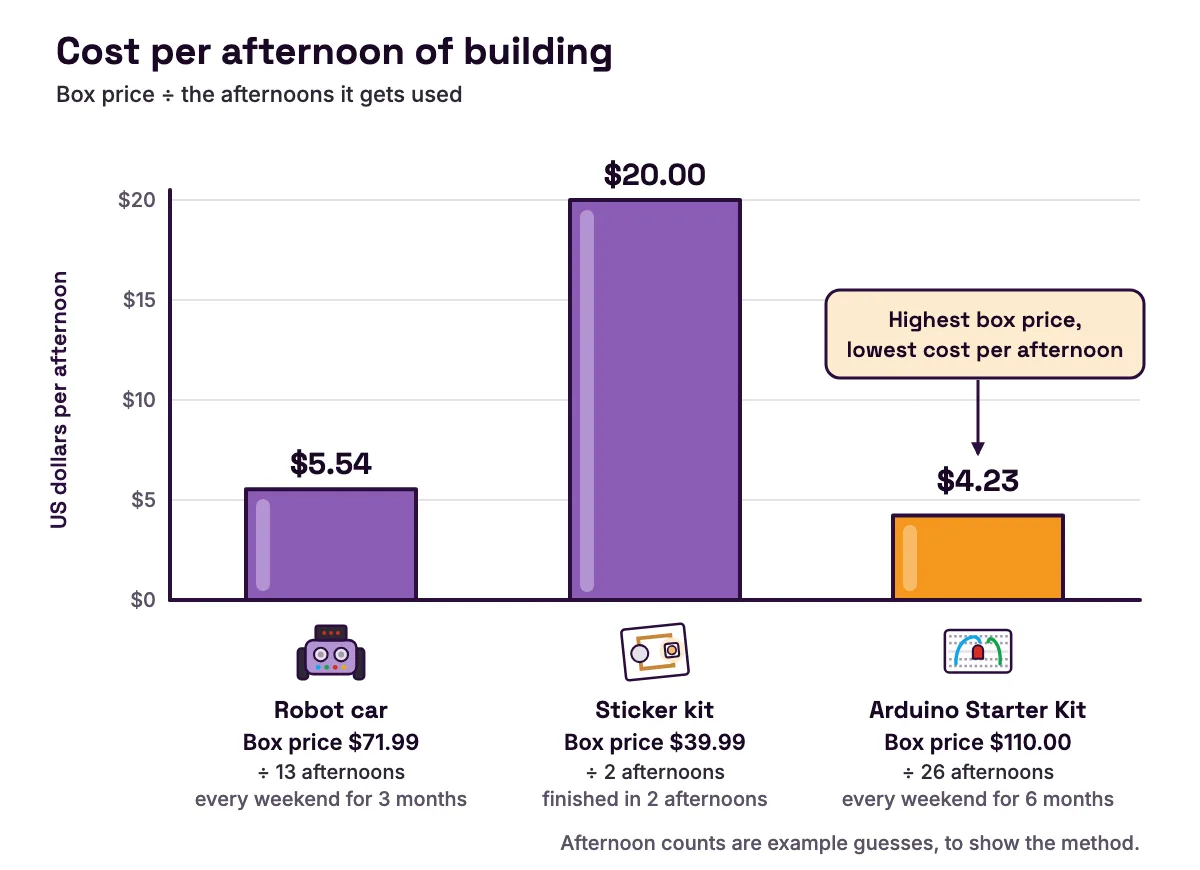
Now work out the cost per session, which the box price hides. A session here is one afternoon of building, and the counts below are guesses to show the method:
- The robot basket, used every weekend for 3 months: $71.99 ÷ 13 = about $5.54 a session.
- A $39.99 sticker kit finished in 2 afternoons: $39.99 ÷ 2 = about $20.00 a session.
- The $110 Arduino Starter Kit, used every weekend for 6 months: $110.00 ÷ 26 = about $4.23 a session.
A kit with a higher ceiling often costs less per afternoon, even when it breaks the budget. Put in your own guess: how long did the last kit last in your house?
Buying in Canada? These are US prices, and Canadian stores price in Canadian dollars, so check a local seller before you compare.
Worked example: a no-code door alarm on the first afternoon
Here is a first afternoon with a building gift, using the Intruder Alert idea from the MakerBuddy project library, with the colour light added. When someone walks into the bedroom, the colour light turns red, the buzzer beeps and the text screen says so. Allow about an hour, with an adult for the Wi-Fi step.
Before the rule.
- 1
Unplug the USB cable. Plug the motion sensor and the text screen into their labelled sockets; the screen's four wires match by name. Never plug parts in while the board has power.
- 2
Power the board. An adult types the Wi-Fi password during the first setup, as in the powering up and connectivity lesson.
- 3
Open the dashboard and wave at the motion sensor. Time how long its card shows motion after you stop. A small knob on the sensor sets that hold time; ask an adult before turning it. The security sensing lesson covers it.
The rule, field by field.
| Field | Setting | Why |
|---|---|---|
| Name | Door guard | Names can be up to 20 characters |
| Loop mode | Condition | The rule runs while its test is true |
| Sensor | Motion Sensor | It only reports true or false |
| Operator and value | Equal to (==), True | Motion seen |
| Step 1 | RGB Red, delay 0 ms | Go straight to the next step |
| Step 2 | Buzzer On, delay 500 ms | A half-second beep |
| Step 3 | Buzzer Off, delay 0 ms | In a rule, the buzzer stays on until a Buzzer Off step |
| Step 4 | LCD Display, "Someone came in" and "Check the door", delay 3000 ms | Each line holds 16 characters |
| Step 5 | RGB Off, delay 1000 ms | Tidy up before the next round |
| Step 6 | LCD Display, Default (Sensor Data), delay 0 ms | The screen goes back to live readings |
- Field
- Name
- Setting
- Door guard
- Why
- Names can be up to 20 characters
- Field
- Loop mode
- Setting
- Condition
- Why
- The rule runs while its test is true
- Field
- Sensor
- Setting
- Motion Sensor
- Why
- It only reports true or false
- Field
- Operator and value
- Setting
- Equal to (==), True
- Why
- Motion seen
- Field
- Step 1
- Setting
- RGB Red, delay 0 ms
- Why
- Go straight to the next step
- Field
- Step 2
- Setting
- Buzzer On, delay 500 ms
- Why
- A half-second beep
- Field
- Step 3
- Setting
- Buzzer Off, delay 0 ms
- Why
- In a rule, the buzzer stays on until a Buzzer Off step
- Field
- Step 4
- Setting
- LCD Display, "Someone came in" and "Check the door", delay 3000 ms
- Why
- Each line holds 16 characters
- Field
- Step 5
- Setting
- RGB Off, delay 1000 ms
- Why
- Tidy up before the next round
- Field
- Step 6
- Setting
- LCD Display, Default (Sensor Data), delay 0 ms
- Why
- The screen goes back to live readings
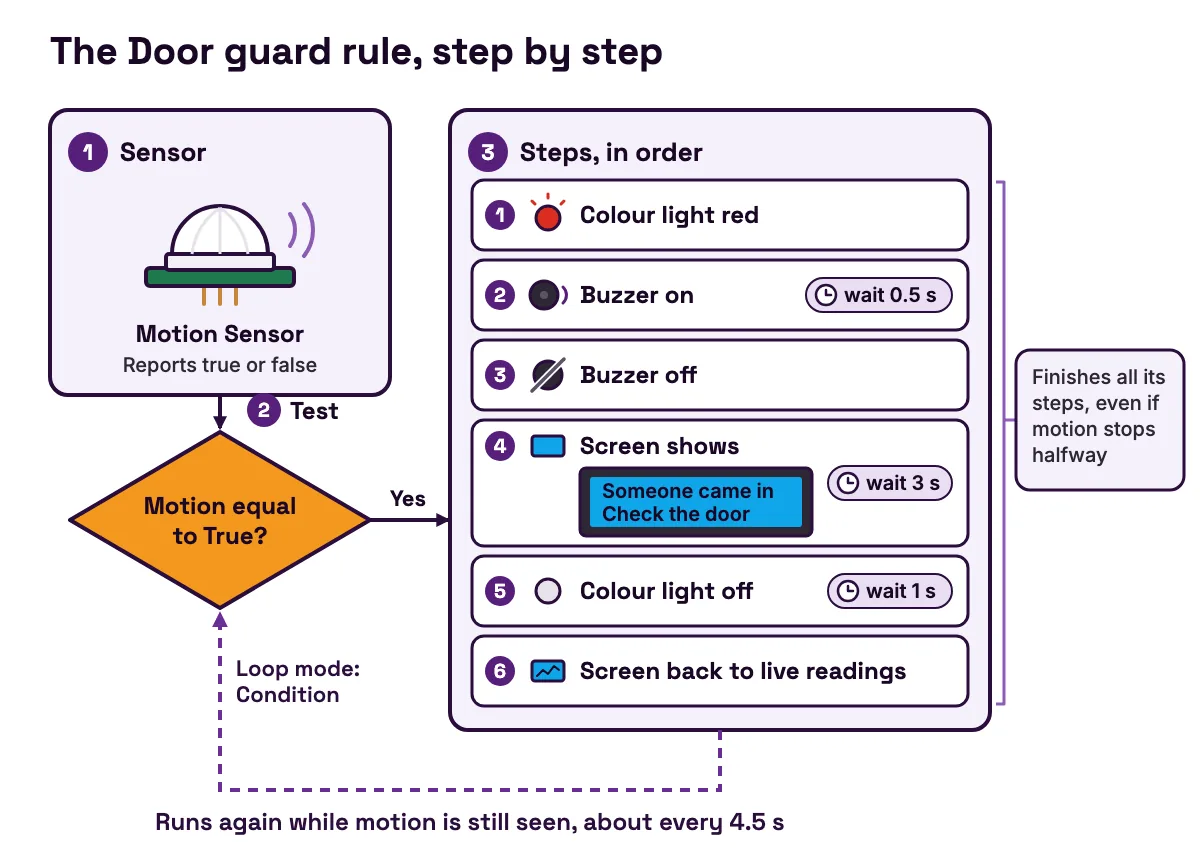
Test it. Save the rule and walk past the sensor. If motion stops halfway, the rule still finishes its steps, so the light always goes back off. While the sensor still reports motion, the rule starts again, so expect another beep about every 4.5 seconds, the length of one round, until the hold time ends. The condition loops lesson explains why, and the text screen lesson shows how to fit a message into 16 characters.
What your child learns. The rule is a real if-then program, built from menus. They also meet two honest limits. The board reads its sensors once a second, so the alarm can start a second or so after someone walks in. And the board has no clock, so the rule cannot record when someone came in; a notebook by the door fixes that.
Common mistakes when buying building gifts
| Symptom | Cause | Fix |
|---|---|---|
| The robot sits still on the big day | Batteries, or a base product such as a micro:bit or the Makey Makey Classic, are sold separately | Read the "also needed" column and buy them together |
| The kit is finished by lunchtime and never touched again | Every project was a fixed booklet with no next step | Pick a gift that can be coded, rebuilt or extended |
| Tears in the first hour | The kit needs wiring or reading beyond today's skills | Choose a fast first win, or sit beside them at first |
| Setup fails at home | The kit's app, browser or Wi-Fi needs do not match your home | Check the device list and your Wi-Fi band before you buy |
| The kit asks for an account your child cannot open | The maker's privacy policy sets a minimum age | Read the product page's FAQ before you buy |
| A home-made alarm is trusted for real | A learning model is treated as a safety device | Keep your home's real smoke and gas alarms |
- Symptom
- The robot sits still on the big day
- Cause
- Batteries, or a base product such as a micro:bit or the Makey Makey Classic, are sold separately
- Fix
- Read the "also needed" column and buy them together
- Symptom
- The kit is finished by lunchtime and never touched again
- Cause
- Every project was a fixed booklet with no next step
- Fix
- Pick a gift that can be coded, rebuilt or extended
- Symptom
- Tears in the first hour
- Cause
- The kit needs wiring or reading beyond today's skills
- Fix
- Choose a fast first win, or sit beside them at first
- Symptom
- Setup fails at home
- Cause
- The kit's app, browser or Wi-Fi needs do not match your home
- Fix
- Check the device list and your Wi-Fi band before you buy
- Symptom
- The kit asks for an account your child cannot open
- Cause
- The maker's privacy policy sets a minimum age
- Fix
- Read the product page's FAQ before you buy
- Symptom
- A home-made alarm is trusted for real
- Cause
- A learning model is treated as a safety device
- Fix
- Keep your home's real smoke and gas alarms
A good building gift makes your child the builder. If you find yourself holding the screwdriver, hand it back. For the bigger picture, read our honest guide to the best STEM kits by age. For a younger brother or sister, see hands-on STEM gift picks for 10-year-olds. More guides are on the MakerBuddy blog.
FAQ
What is the best present for a 12-year-old?
The best present matches something they already love and lets them make something of their own. For a child who builds, that means a programmable board, a robot car or a sensor kit, chosen by budget. The CPSC's Age Determination Guidelines (opens in a new tab) note that children aged 9 through 12 often prefer raw materials to finished products.
What is a good present for a 12-year-old boy?
Pick by interest, not by the fact that he is a boy. A 12-year-old who loves building usually wants something real he can change: a robot car, a programmable board or an invention kit. Under $30, the micro:bit v2 Go Bundle (opens in a new tab) at $19.95 is a strong start.
What are good building gifts for 12 year old girls?
The same gifts that suit boys, chosen by interest. A girl who loves art may enjoy circuit stickers, one who loves music a Makey Makey, and one who loves robots a Cutebot Pro or Sphero BOLT+. Choose by what the parts can do, not by the colour of the box.
What are some unique gifts for a 12-year-old?
A gift they build and then reinvent stands out more than one they unwrap and finish. Think of a motion alarm for their bedroom door, a robot car they code to follow a line, or a banana piano made with a Makey Makey. Add a small toolbox so the building keeps going.
What is a good educational gift for a 12-year-old?
A programmable board teaches coding and electronics for under $30: Adafruit lists the Circuit Playground Express (opens in a new tab) at $24.95. For more structure, choose a kit with lessons or a project book, such as the Arduino Starter Kit or MakerBuddy. The best educational gifts do not feel like homework.
What should I get an 11 to 12 year old for Christmas?
Pick a gift with a fast first win, wrap the batteries and cables with it, and check the app, account and Wi-Fi needs beforehand. A micro:bit, a Makey Makey or a robot car with its micro:bit can all work on the first afternoon if the extras are ready.
Is a 14+ kit too hard for a 12-year-old?
Not always. In the CPSC's Age Determination Guidelines (opens in a new tab), a children's product is one designed mainly for children aged 12 or younger, so a 14+ label partly reflects who the maker designed it for. Some 14+ advice is about accounts and privacy rather than difficulty, as on the Arduino Plug and Make Kit (opens in a new tab) page. Check for small parts, sharp tools, heat and mains power first.
Do building kits for 12-year-olds need a computer or Wi-Fi?
Many do. The Circuit Playground Express, Makey Makey and Arduino kits need a computer, the micro:bit works from a computer, tablet or phone, and Sphero needs its app. MakerBuddy needs a computer with Chrome, Edge or Firefox and its free extension, or Safari on a Mac, iPhone or iPad, plus 2.4 GHz Wi-Fi.
Sources
- U.S. Consumer Product Safety Commission: Age Determination Guidelines (January 2020) (opens in a new tab)
- Purdue University INSPIRE: Engineering Gift Guide 2025 (opens in a new tab)
- Purdue Engineering Gift Guide: Chibitronics LED Circuit Sticker Kits (opens in a new tab)
- Purdue Engineering Gift Guide: Smart Cutebot Pro by ELECFREAKS (opens in a new tab)
- Purdue Engineering Gift Guide: Makey Makey Backpack Bundle (opens in a new tab)
- Purdue Engineering Gift Guide: Sphero BOLT+ and Sphero Blueprint Engineering Kit (opens in a new tab)
- Purdue Engineering Gift Guide: ELECFREAKS micro:bit Nezha Pro Ocean Kit (opens in a new tab)
- Adafruit: micro:bit v2 Go Bundle (opens in a new tab)
- Adafruit: Circuit Playground Express (opens in a new tab)
- micro:bit Educational Foundation: micro:bit features overview (opens in a new tab)
- micro:bit Educational Foundation: Let's code (opens in a new tab)
- SparkFun: Makey Makey Classic by JoyLabz (opens in a new tab)
- Arduino US Store: Arduino Plug and Make Kit (opens in a new tab)
- Arduino US Store: Arduino Starter Kit Multi-Language (opens in a new tab)